The Future of Digital Art is in Good Hands
- info56598806
- Sep 10, 2025
- 5 min read
Several threads have come out this week lamenting on the recent news that Christie’s plans to shut down its digital art department.
To me, this news appears as a symptom of a declining traditional art market, with much less doom and gloom consequences for the future of the digital art market. In fact, it might actually be very good news for it.

Christie’s is a British auction house, founded in 1766. It stands as one of the top four auction houses worldwide, alongside the likes of Sothebys and Phillips, with Christie’s netting around $5.7billion in sales last year alone.
As a company they’ve been consistently forward thinking with their implementation of blockchain technology and acceptance of digital art. In 2021, Christie’s were the auction house that helped kickstart the NFT bull run, by putting to auction Beeple’s piece ‘EVERYDAYS: THE FIRST 5000 DAYS’, shattering records and expectations when it sold for $69 million. Outside of this mind-boggling price tag, it was historic also as the first time purchases of an artwork at Christie’s could be made in Ether. This led to the launch of Christie’s 3.0 in September 2022 – their online auction platform for NFTs. Their releases were quite sporadic through the platform, the last of which was at the end of 2024.

On the tech side, they introduced digital authentication via the blockchain to select collectors – a way of providing ‘a clear and transparent provenance record of the piece of art they were purchasing, a record that could never be erased or manipulated, and is accessible worldwide’. This marks an interesting shift in proof of ownership within the traditional art market, a move away from reliance on physical provenance keeping and instead using blockchain contracts for an extra layer of security and transparency. As Dorian Batycka notes in their Art Newspaper article, ‘It is not just about owning the work anymore—it is about owning a part of its history in a way that is immutable and accessible worldwide.’ It should also be noted that this was introduced not for a set of digital works, but instead a collection of photographic prints, including ones by Nan Goldin and Cindy Sherman.
This happened the same month as the auction for ‘Ascend’ by Ryan Koopmans & Alice Wexell – the first time a work minted on the Bitcoin Ordinals protocol had been sold at auction by Christie’s. It’s a live digital piece that changes its lighting in sync with whether it’s day or night – especially technically impressive considering that Bitcoin doesn’t have smart contracts to easily mint and create NFTs like ETH/SOL does and instead relies on ‘recursion coding’ to overcome the file size limits.

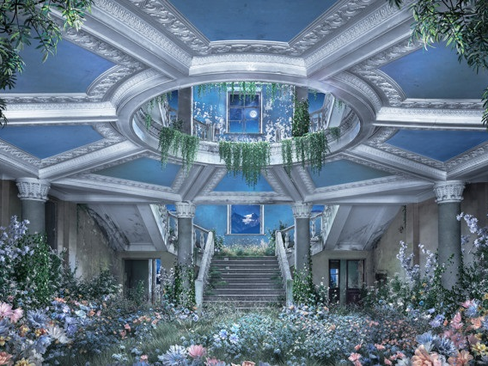


‘Ascend’ by Ryan Koopmans & Alice Wexell
So what went wrong, and why are they shuttering their digital art department? People have been slightly melodramatic on this: although the department is shutting down, they’re not stopping auctioning digital works. A spokeperson from Christie’s told Now Media, the reporters who broke this story, that the company will “continue to sell digital art within the larger 20th and 21st Century Art category”.
To me, this seems a reflection of an art market in decline: the Financial Times reports today that ‘Sotheby’s annual loss more than doubles to $248mn’, in what is now a multi-year slump in the art market. To combine their auctions into a larger category is an easy cost to cut, which is clearly part of the aim, as two staffers of the department were let go at the end of August. This is happening among other changes under the new CEO Bonnie Brennan, who joined in February.
The decline in the art market is being made increasingly apparent: LA’s top gallery Blum is shutting down, works with large estimates are struggling to find buyers, Inigo Philbrick is being given airtime on the BBC after conducting over $80m in fraudulent art deals, and headlines such as ‘Is the art market coming to the end of the age of eternal growth?’ all seem to show this trouble being felt.
However, I don’t think the Christie’s news is bad news: in fact, to move digital art into their standard categories does a lot to legitimise ‘digital art’ as ‘art’ – something that has been a struggle since the inception of computers.

Lillian Schwartz was a pioneer of computer-mediated art, ‘an artist who uses computers, never a computer artist’, and was the first artist to have computer made work in the MoMA. She tells the story: "When I told [MoMA] in 1972 that I had a piece of computer art, they rejected it. A year later, I submitted it as a silkscreen, never mentioning computer art. It won an award, and they bought it."
The tide has shifted somewhat, and that’s apparent in the MoMA having many digital works, including AI works, in their collection, but I believe that this need to legitimise work through the physical for galleries and museums to understand it (and for them to be able to sell it) still exists. Maybe this switch for Christie’s will mark the start of other institutions pushing past the need to single ‘digital art’ out for it’s ‘digitalness’?
The other exciting part about this closure is that the taste-making returns to those truly involved in the actual-making.
If there is no digital art department by someone like Christie’s, collectors still interested will have to go elsewhere for this type of work: and this is where we come in.
We’ve seen an explosion in mints and collection releases via VVV.so, the artist run NFT platform by the guys at Yeche Lange, since it’s launch (which has also done wonders to legitimise SOL as an art chain to ETH collectors who looked down upon it as simply the gambling chain it often appears to be on the surface). There’s clear proof that platforms ran by artists for artists will be the most important part of the next NFT bullrun – we have the understanding of what features are needed, the importance of works, the creativity to make it happen and nothing to lose by trying.
There’s motion across the board: Yeche Lange continues it’s efforts in NYC as the key physical gallery space for the Avant/Gay NFT scene. There’s the soon-to-open Exchange.art and Bonk Art Master backed Cycol Gallery, an artist run marketplace, gallery and platform that aims to create a new movement of artists working between digital and physical works. There’s Verse, the ETH native, online-only gallery pushing some incredible collections and artists (both new and historical), while allowing minting across fiat, SOL, ETH, etc.. These are not soulless, old-guard, gate-kept institutions, but highly accessible platforms and places to create art or to get inspired by art.
This is only to talk of platforms that have been impressing me recently, and nothing to talk about the mind-blowing, meta-smashing and genre-bending works and collections we’ve seen drop in our scenes recently.
The art is absolutely in the hands of the artists, and with vibe coding and other new technology, it’s never been more timely (nor easier!) for us to create what we want to see in terms of an ‘art market’.
- Lowbie
Links:
Cover image from 'Haircuts', at Yeche Lange (Earl Negative Oil / Cuckfella, 2024 85 x 60 in. 216 x 152 cm Oil and paper on canvas): https://www.yl.baby/nyc-galerie?show=haircuts
Christie’s shutters digital art market: https://nowmedia.co/posts/christies-shutters-digital-art-department
Christie’s October 2024 blockchain works: https://theartnewspaper.com/2024/10/11/from-ordinals-to-ownership-christies-explores-new-frontiers-of-blockchain-based-provenance
Christies and ETH: https://theartnewspaper.com/2021/02/19/christies-to-accept-cryptocurrency-for-first-time
Sothebys Losses: https://ft.com/content/b6990ba1-cd11-4b5a-a93c-21a6b84cdf77
Is the art market coming to the end of eternal growth?: https://theartnewspaper.com/2025/04/15/are-we-coming-to-the-end-of-the-age-of-eternal-growth
Lillian Schwartz: https://x.com/Noahbolanowski/status/1965064317088448563
http://VVV.so @vvvdotso / @cycol_gallery / @yeche_lange http://yl.baby / @verse_works http://verse.works
Originally published here September 11th, 2025.


Comments